Canada Immigration – Refugee Claim Eligibility Canada
Canada Immigration – Refugee Claim Eligibility Canada
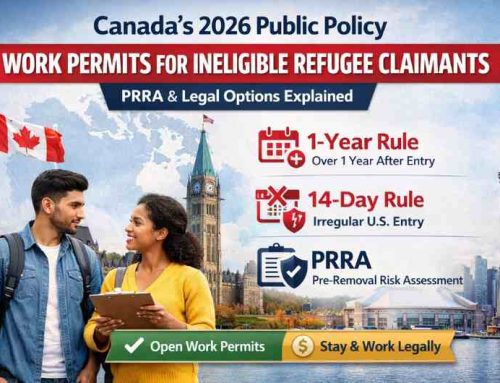
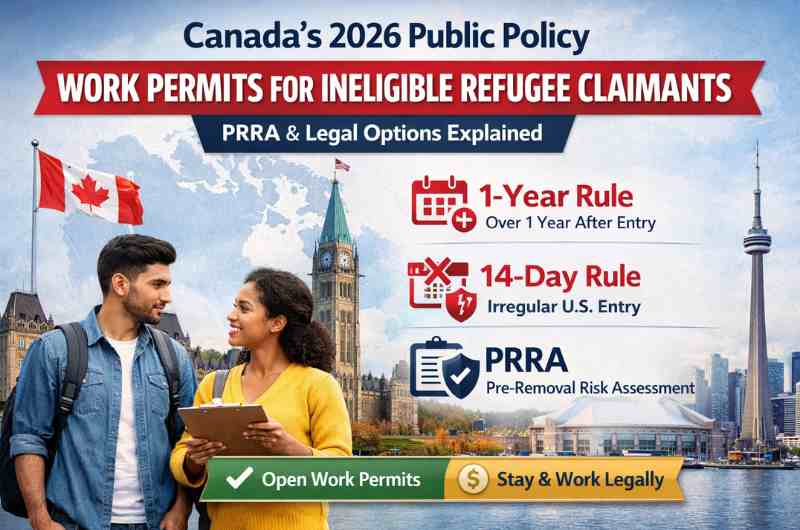
This screening step has become even more important following newer ineligibility rules now reflected in IRCC’s operational guidance, including the one-year bar and the 14-day irregular entry rule.
Why eligibility matters
If a refugee claim is found eligible, it can be referred to the RPD for a full hearing on the merits. If it is found ineligible, the person usually cannot proceed to the IRB on that claim. In some cases, other remedies may still exist, such as a Pre-Removal Risk Assessment (PRRA), depending on the reason for ineligibility.
Main grounds of ineligibility
IRCC’s guidance lists several grounds under section 101 of IRPA that can make a refugee claim ineligible for referral to the RPD.
1) The person is already protected in Canada
A claim is not eligible if the person has already become a protected person in Canada. This includes someone who already received protection through refugee resettlement, was previously found to be a refugee by the IRB, or had a positive PRRA decision.
2) A previous refugee claim was rejected
A person is generally ineligible if they already made a refugee claim in Canada that was rejected by the IRB, including under previous immigration legislation. However, IRCC notes that a refused overseas resettlement application or a refused PRRA alone does not automatically trigger this specific bar if the person’s refugee protection concerns were never heard by the IRB.
3) The one-year bar
Under paragraph A101(1)(b.1), a claim is ineligible if the person entered Canada after June 24, 2020 and made the refugee claim more than one year after the day of entry. IRCC also states that if the person later left Canada and returned, the one-year period is still calculated from the first entry.
4) The 14-day irregular entry rule
Under paragraph A101(1)(b.2), a claim is ineligible if the person entered Canada from the United States between ports of entry and made the refugee claim 14 or more days after entry into Canada.
- Transitional rule – IRCC’s guidance states that the new rules in A101(1)(b.1) and A101(1)(b.2) apply only to claims made on or after June 3, 2025.
5) A previous claim was found ineligible, withdrawn, or abandoned
A refugee claim is also ineligible if the person previously made a claim that was found ineligible, or if the IRB determined that the earlier claim was withdrawn or abandoned.
6) The person claimed asylum in another information-sharing country
A claim may be ineligible if, before claiming in Canada, the person already made a refugee claim in a country that has an information-sharing agreement with Canada. Importantly, IRCC says a personal declaration alone is not enough. The existence of that foreign claim must be confirmed through information-sharing.
7) The person already has refugee protection in another country
A claim is not eligible if the person has already been recognized as a Convention refugee by another country and can return there. IRCC applies a two-part test:
- Was the person recognized as a Convention refugee by another country?
- Can the person return to that country?
If the country will not readmit the person, this ground may not apply. IRCC also notes that U.S. “Withholding of Removal” status can count for this purpose, but officers must still confirm whether the person would actually be readmitted.
8) Safe Third Country Agreement (STCA)
A claim may be ineligible if the person arrives directly or indirectly from a designated safe third country. According to the IRCC guidance, the United States is currently the only country designated for this purpose. Claims made by persons arriving at a land border port of entry from the U.S. may therefore be ineligible, unless an exception or exemption applies under the STCA rules.
9) Serious criminality, security, human rights violations, or organized criminality
A claim may be ineligible where the person is inadmissible for serious criminality, security, violating human or international rights, or organized criminality. In some of these cases, eligibility cannot be decided immediately because the matter must first go through admissibility procedures, including a section 44 report and possible referral to the Immigration Division.
IRCC also explains that serious criminality can make a claim ineligible where the relevant conviction is punishable by a maximum term of at least 10 years in prison in Canada, or would be punishable that way if committed in Canada.
Can an ineligible claimant still have other options?
Sometimes, yes. IRCC’s guidance notes that a person found ineligible under paragraph A101(1)(d) or A101(1)(f) may still have access to a risk assessment, including PRRA in appropriate cases. That does not mean every ineligible claimant has the same remedy, but it does mean ineligibility at the IRB stage is not always the end of the legal analysis.
Important takeaway
The refugee eligibility stage is now more technical than ever. Timing, manner of entry, prior claims in Canada or abroad, protection in another country, STCA issues, and criminal inadmissibility can all affect whether a claim will even reach the IRB.
If you or your family member are thinking about making a refugee claim in Canada, it is very important to get legal advice before filing. A mistake at the eligibility stage can have serious consequences.
Key Asylum Eligibility Changes
The table below provides a simplified overview of the main legal grounds under IRPA section 101 that may make a refugee claim ineligible to be referred to the Immigration and Refugee Board (IRB). This summary is intended to help readers quickly understand complex eligibility rules before reviewing the detailed explanations above.
| Ground of Ineligibility | Legal Reference | What It Means (Simple Explanation) | Key Notes |
|---|---|---|---|
| Already protected in Canada | A101(1)(a) | You already have refugee protection in Canada | Includes resettled refugees, IRB-approved claims, or positive PRRA |
| Previous claim rejected | A101(1)(b) | You made a refugee claim before and it was refused | Applies even under older laws |
| 1-year rule | A101(1)(b.1) | You applied more than 1 year after entering Canada | Applies to entries after June 24, 2020 |
| 14-day irregular entry rule | A101(1)(b.2) | You crossed from the U.S. irregularly and waited more than 14 days | Applies only to claims after June 3, 2025 |
| Previous claim withdrawn/abandoned | A101(1)(c) | You had a claim before but didn’t continue it | Includes withdrawn or abandoned claims |
| Claim in another country | A101(1)(c.1) | You already claimed asylum in another partner country | Must be confirmed through info-sharing |
| Protected in another country | A101(1)(d) | You already have refugee status elsewhere | Only applies if you can return there |
| Safe Third Country (U.S.) | A101(1)(e) | You came through the U.S. at a land border | Exceptions may apply |
| Serious criminality / security | A101(1)(f) | You are inadmissible due to serious crime or security concerns | Usually requires admissibility hearing first |
Important: Even if a refugee claim is found ineligible, some individuals may still qualify for other protections such as a Pre-Removal Risk Assessment (PRRA), depending on their situation, read our full guide here → IRCC
Assessment Form: Click here