Canada Immigration Daily Update – January 27, 2026
Canada Immigration Daily Update – January 27, 2026
Canadian Immigration Daily Brief – January 27, 2026
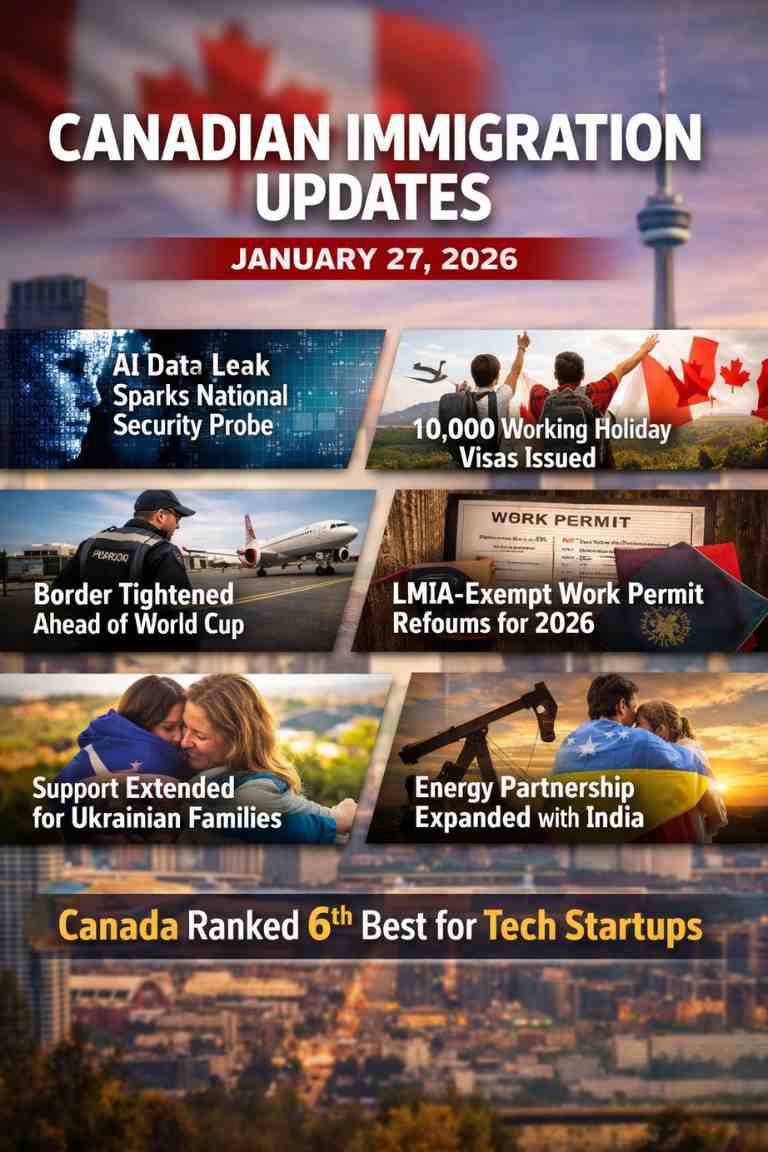
Canada’s immigration landscape saw major developments today, led by a national security investigation into a leak of AI-generated immigration assessment scores, raising concerns about data protection and transparency in decision-making. At the same time, Canada issued over 10,000 Invitations to Apply in the first 2026 Working Holiday Visa draw, signaling exceptionally strong global demand. Authorities are also tightening border vigilance ahead of the World Cup due to potential asylum surges. On the policy front, Canada announced sweeping reforms to LMIA-exempt work permits effective 2026, extended temporary status options for Ukrainian family reunification applicants until 2027, strengthened mobility ties with Japan for short-term technical workers, and expanded energy cooperation with India. Separately, Canada ranked sixth globally for tech startup growth, reinforcing its position as a key destination for innovation and skilled talent.
AI Immigration Data Leak Triggers National Security Investigation
Canadian federal authorities have launched a national security inquiry following the unauthorized disclosure of sensitive immigration assessment data by a government employee. The leaked information reportedly involved scores generated or filtered by artificial intelligence systems used in Canada’s immigration application process.
AI-supported tools have become increasingly central to how applications are screened, triaged, and prioritized, particularly in high-volume programs. While officials have not confirmed that final decisions were directly exposed, the disclosure of internal scoring metrics has raised serious concerns around data governance, system integrity, and institutional safeguards.
Beyond the immediate security implications, the incident has reignited broader debates around algorithmic transparency and accountability in public decision-making. Immigration advocates and legal professionals are questioning how applicants can meaningfully challenge decisions if AI-assisted scoring models remain opaque.
The federal inquiry is expected to examine employee access controls, internal audit mechanisms, and ethical oversight of AI deployment across immigration programs. Its findings could influence future restrictions on automated decision tools and reshape how technology is used in life-altering immigration determinations.
Over 10,000 Invitations Issued in First 2026 Working Holiday Draw
Canada has begun the 2026 International Experience Canada (IEC) season with an unusually large initial draw, issuing more than 10,000 Invitations to Apply (ITAs) under the Working Holiday category.
This early surge reflects sustained global demand for temporary work and travel opportunities, particularly among young applicants seeking Canadian experience. The size of the first draw suggests that immigration authorities are moving aggressively to clear existing candidate pools and manage processing timelines early in the year.
While the total 2026 IEC quota has not yet been formally announced, such a high opening round points to continued program prioritization. Historically, large initial draws have benefited well-prepared candidates already in the pool, while late entrants often face tighter competition as the season progresses.
For employers and applicants alike, the early momentum signals that Working Holiday remains a cornerstone of Canada’s youth mobility strategy and an important entry point into the broader Canadian labour market.
World Cup Preparations Raise Asylum and Border Control Concerns
Immigration authorities have reportedly placed border and asylum operations on heightened alert ahead of the upcoming World Cup tournament. Large-scale international sporting events are historically associated with increased irregular migration risks due to high volumes of short-term visitors and accelerated border processing.
Officials are preparing for the possibility that some individuals may attempt to enter the country under the guise of tourism or event attendance and subsequently file asylum claims. Predictive modeling and past experience appear to have informed contingency planning across airports and land ports of entry.
The operational response is expected to include additional screening measures, deployment of specialized investigative teams, and closer monitoring of travel cohorts linked to the tournament. Authorities have emphasized the need to balance efficient entry for legitimate visitors with the integrity of refugee protection systems.
This development highlights how global events increasingly intersect with immigration enforcement and humanitarian policy, particularly during periods of concentrated international travel.
Canada–Japan Agreement Simplifies Short-Term Technical Work
Japan and Canada have concluded a bilateral agreement aimed at simplifying short-term work authorization for technical specialists moving between the two countries.
The agreement is designed to reduce administrative delays for companies requiring rapid deployment of highly skilled personnel, particularly in sectors such as advanced manufacturing, information technology, and engineering services. Previous frameworks often involved lengthy visa processing that hindered time-sensitive projects.
By streamlining short-term authorization requirements, both governments are signaling a commitment to facilitating knowledge transfer and cross-border innovation. The move is also consistent with broader efforts to enhance economic cooperation and competitiveness in high-tech industries.
While program-specific guidance has yet to be released, employers should expect clearer pathways for short-duration technical assignments once implementation details are finalized.
Major Reforms Coming to LMIA-Exempt Work Permits in 2026
The federal government has confirmed that significant changes to LMIA-exempt work permit categories will take effect in 2026. These permits, which operate outside the Labour Market Impact Assessment framework, are widely used for intra-company transferees, trade-related professionals, and roles deemed to provide significant benefit to Canada.
Although detailed regulations have not yet been published, officials have characterized the reforms as structural rather than incremental. Possible changes may include revised eligibility criteria, altered permit durations, or tighter alignment with labour market objectives.
For employers heavily reliant on LMIA-exempt pathways, the announcement introduces a period of uncertainty that will require close monitoring. Advance planning and early legal assessment may become increasingly important as the new framework takes shape.
Temporary Status Extended for Ukrainian Family Reunification Applicants
Canada has extended access to temporary residence options for Ukrainian nationals who applied under the family reunification permanent residence pathway launched in October 2023.
Eligible applicants and their family members now have until March 31, 2027, to apply from within Canada for open work permits, study permits, extensions of existing permits, or restoration of temporary resident status. Importantly, applications may be submitted even if an acknowledgement of receipt for permanent residence has not yet been issued.
This measure reflects Canada’s ongoing response to the humanitarian consequences of Russia’s invasion of Ukraine and aims to provide stability for families awaiting permanent decisions. Standard government fees continue to apply.
Canada Ranked Sixth Globally for Tech Startup Growth
A newly released global index has ranked Canada as the sixth-best country worldwide for technology startup growth. The ranking highlights a supportive innovation ecosystem characterized by access to talent, capital, and infrastructure.
This recognition reinforces Canada’s position as an attractive destination for entrepreneurs and skilled immigrants seeking opportunities in the technology sector. Strong startup performance also has downstream implications for immigration, as high-growth companies often rely on global talent mobility.
For policymakers, the ranking underscores the importance of aligning immigration pathways with innovation-driven economic strategies to sustain long-term competitiveness.
Canada and India Expand Energy Cooperation
India and Canada are moving toward expanded cooperation in oil and natural gas exports, marking a notable shift in bilateral relations. The development follows signs of improved diplomatic engagement between the two countries.
As India’s energy demand continues to rise alongside economic growth, Canada is positioning itself as a reliable supplier within a diversified import strategy. For Canada, the move supports market diversification and strengthens economic ties in the Indo-Pacific region.
Further details on export volumes and implementation timelines are expected in upcoming bilateral discussions, with both governments emphasizing regulatory coordination and logistical efficiency.
Source: NEXUS Conferences & Canadian media sources
Assessment Form: Click here