Canada Immigration Daily Update – January 26, 2026
Canada Immigration Daily Update – January 26, 2026
Canadian Immigration Daily Brief — January 26, 2026
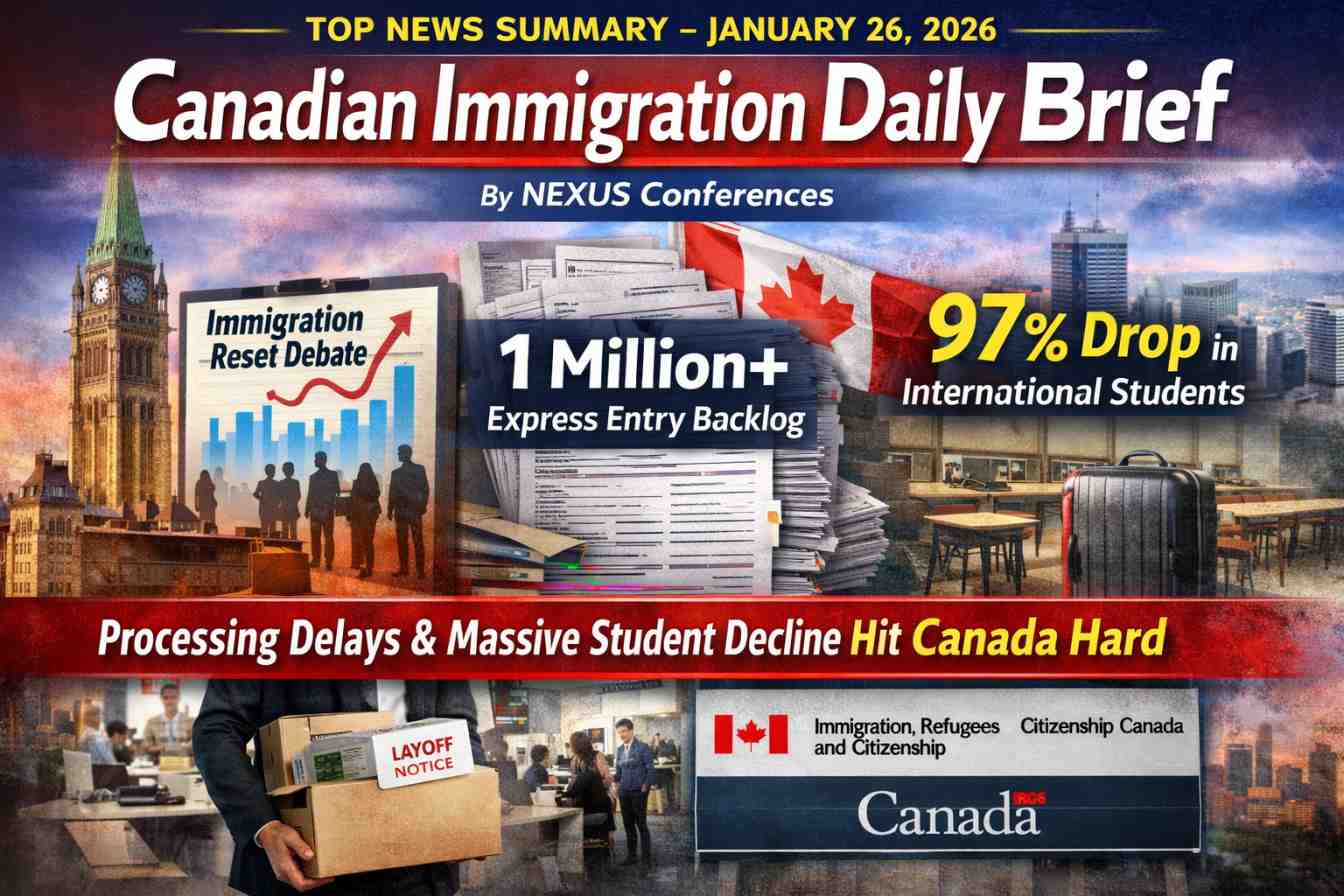
Canada’s immigration system is facing mounting pressure as policymakers debate a long-overdue national “immigration reset” amid worsening backlogs and service strain. IRCC has released January 2026 processing times, highlighting faster citizenship and PR card renewals, but systemic delays persist—most notably in Express Entry, where the backlog has now surpassed one million applications. At the same time, new IRCC data confirms a historic collapse in international student arrivals, with reported intake dropping by up to 97%, raising serious concerns for Canada’s education sector and urban economies. These challenges are unfolding alongside major federal public service layoffs, intensifying questions about the government’s capacity to deliver immigration services effectively in 2026 and beyond.
Immigration at a Crossroads: Is a True National Reset Finally Possible?
The idea of an “immigration reset” has once again entered Canada’s policy discourse, reflecting growing concern that incremental adjustments are no longer sufficient to manage population growth, labour shortages, and integration pressures. For decades, immigration planning in Canada has leaned toward reactive decision-making—raising or lowering intake targets in response to short-term political or economic pressures rather than embedding immigration within a coordinated national strategy.
A genuine reset would require far more than recalibrating annual admission numbers. Experts emphasize the need for synchronized planning across labour markets, housing supply, public infrastructure, and settlement services. When these systems operate in isolation, communities absorb the strain while newcomers face delays, affordability challenges, and uneven access to support.
Policy analysts increasingly argue that credibility now hinges on execution. Aspirational targets must be backed by measurable benchmarks, clear accountability, and built-in feedback loops that allow policies to adapt quickly when conditions shift. Provinces, municipalities, and employers—who ultimately absorb newcomers—must be meaningfully involved in planning rather than consulted after decisions are finalized. Without this structural shift, today’s “reset” risks becoming another cycle of temporary fixes rather than a durable framework for long-term economic stability and social cohesion.
January 2026 Processing Times: Faster Citizenship and PR Card Renewals Highlighted
Immigration, Refugees and Citizenship Canada has released updated processing times for January 2026, offering applicants a clearer picture of expected timelines. While processing backlogs remain a concern across multiple streams, IRCC has signaled notable improvements in two high-impact areas: citizenship applications and permanent resident card renewals.
Accelerated timelines in these categories suggest that internal streamlining measures are beginning to ease long-standing administrative bottlenecks. For applicants nearing the final stage of their immigration journey, faster citizenship processing represents more than efficiency—it directly affects civic participation, mobility, and long-term security. Similarly, timely PR card renewals are critical for permanent residents who rely on valid documentation for travel and employment continuity.
Although IRCC has not yet released granular data for all streams, the emphasis on these core services indicates a strategic focus on reducing friction for established residents. Applicants are still advised to consult official IRCC tools for stream-specific timelines, particularly for economic and temporary resident categories where delays remain uneven.
International Student Intake Collapses: IRCC Data Confirms a 97% Drop
New data has revealed an unprecedented contraction in Canada’s international student intake, with arrivals reportedly falling by as much as 97% compared to previous periods. This dramatic decline represents more than a cyclical slowdown—it signals a structural shock to a sector that has long underpinned Canada’s post-secondary financing model.
Universities and colleges, particularly in major urban centres, depend heavily on international tuition to sustain operations. A collapse of this magnitude forces institutions to reassess enrolment strategies, staffing levels, and long-term financial viability. Beyond campuses, the ripple effects extend to housing markets, local economies, and labour pipelines that historically relied on international graduates.
While multiple factors are under examination—ranging from tighter visa policies and processing delays to global competition and rising living costs—the scale of the decline underscores the urgency of policy clarity. Rebuilding confidence among prospective students will require transparent rules, predictable processing, and a clear articulation of Canada’s long-term position in the global education market.
Looking Ahead to 2026: What Canada’s Immigration Landscape May Bring
As Canada approaches the mid-decade mark, attention is turning to how 2026 will shape the trajectory of immigration planning. Multi-year immigration levels plans mean that targets set now will define labour market outcomes, demographic balance, and humanitarian commitments for years to come.
For applicants, employers, and advisors, forward-looking analysis is essential. Anticipated priorities will likely reflect labour market gaps, regional distribution objectives, and continued pressure to balance economic intake with processing capacity. Understanding these trends allows prospective immigrants to plan strategically—whether through language testing, credential assessments, or program selection—rather than reacting to sudden policy shifts.
Federal Workforce Reductions Raise Service Delivery Concerns
Significant workforce reductions across the federal public service have raised questions about the government’s capacity to maintain service standards during a period of elevated demand. Reports indicate that thousands of employees across multiple departments have received layoff notices, with critical agencies among those affected.
Cuts in departments tied to health, regulation, and service delivery have prompted concern among unions and policy observers. While fiscal restraint is framed as a long-term budgetary necessity, the immediate impact may be felt through slower processing, reduced oversight, and increased strain on remaining staff—particularly in systems already facing backlogs.
Express Entry Backlog Surpasses One Million Applications
Canada’s flagship economic immigration system is facing mounting operational pressure as the Express Entry backlog has reportedly exceeded one million applications. This figure represents the largest accumulation since 2022 and highlights persistent capacity constraints despite modernization efforts.
For skilled workers and employers, the implications are significant. Extended processing times delay workforce entry, disrupt family planning, and undermine Canada’s competitiveness in attracting global talent. Stakeholders continue to call for transparent reporting and accelerated clearance strategies to restore confidence in the system’s efficiency.
Strategic Immigration and Economic Vision: A Long-Term Instrument
Recent analysis has framed Canada’s immigration system as more than a social policy tool, positioning it instead as a central pillar of long-term economic strategy. By emphasizing skills selection and human capital, immigration is increasingly viewed as a mechanism for sustaining productivity, innovation, and adaptability in a rapidly changing global economy.
In this context, immigration policy is not merely about filling immediate labour gaps but about shaping the country’s future economic resilience. The effectiveness of this approach, however, depends on execution—aligning intake with infrastructure, services, and processing capacity to ensure that strategic ambition translates into tangible outcomes.
Source: NEXUS Conferences & Canadian media sources
Assessment Form: Click here