Canada Immigration Daily Update – January 07, 2026
Canada Immigration Daily Update – January 07, 2026
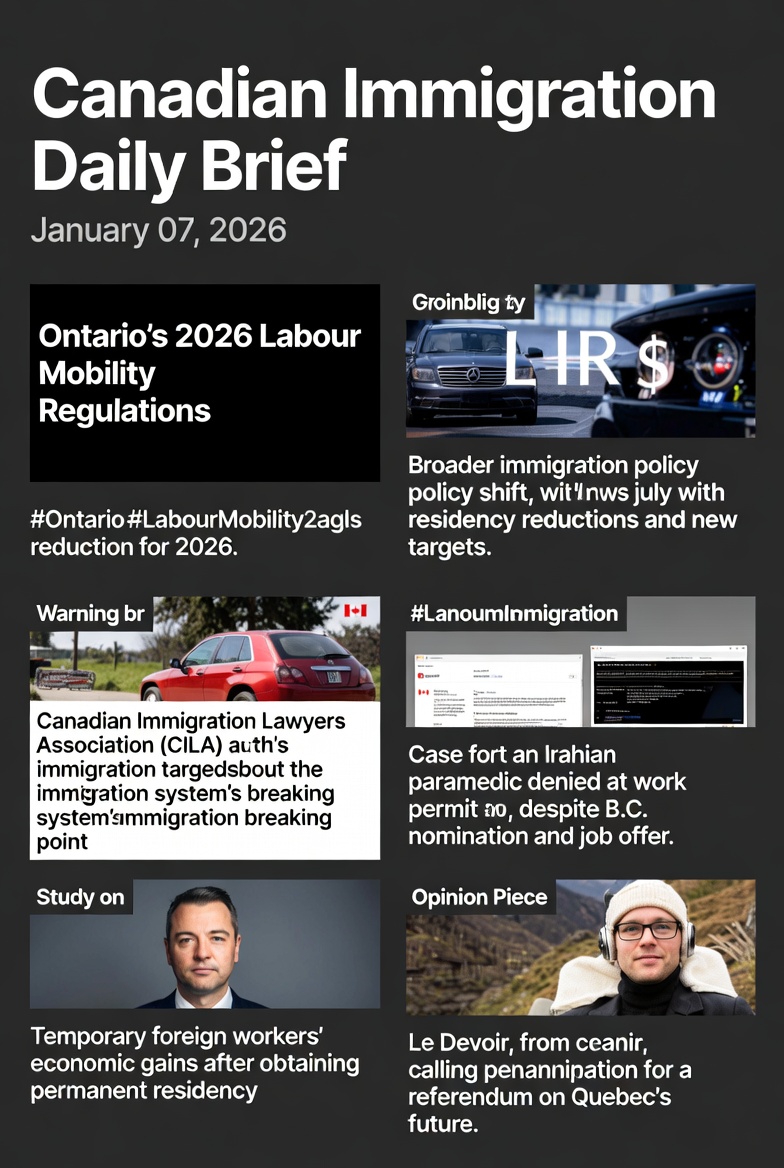
Canadian Immigration Daily Brief — January 07, 2026
Ontario is preparing to introduce 2026 Labour Mobility Regulations that could modernize how skilled professionals move into jobs—especially in regulated fields—by improving credential recognition and workforce access. The changes are expected to help talent reach high-need sectors faster and may influence labour mobility trends beyond Ontario. Stakeholders are watching closely as the 2026 rollout approaches, since the new rules could reshape hiring and integration across Canada’s skilled workforce.
Ontario’s 2026 Labour Mobility Regulations
Ontario is moving toward major changes in how skilled professionals can work across roles and regulated settings, with “Labour Mobility Regulations” expected to come into effect in 2026. Coverage highlighted by Immigration Canada suggests the province is aiming to modernize rules that affect licensing, recognition of credentials, and workforce access—so talent can move more efficiently to where it’s needed.
If implemented as described, the policy could influence not only Ontario’s labour market but also broader interprovincial labour mobility and recruitment trends across Canada. For employers and newcomers, this is a development to monitor closely because it may change how quickly certain professionals can enter or re-enter their fields.
Tags: #Ontario #LabourMobility2026 #SkilledWorkforce #CanadaImmigration
Immigration targets to be reduced again for 2026
Reporting referenced by CityNews Winnipeg indicates the federal government is preparing additional reductions to Canada’s planned newcomer intake levels for 2026. The message signals a continued shift toward tightening overall arrival targets compared to earlier projections.
For applicants, lower targets can translate into more competition and more selective pathways, depending on how reductions are distributed between permanent residence streams and temporary resident programs.
Tags: #CanadaImmigration #ImmigrationCuts #Canada2026 #PolicyUpdate
2026 immigration policy shift: residency reductions + new targets
Separate commentary (cited as InsideHalton) points to a broader immigration policy reset expected to take fuller shape in 2026, including lower residency levels and updated strategic targets. The framing emphasizes aligning immigration planning with capacity pressures—such as processing resources, housing, and public services—while still supporting economic priorities.
If these changes proceed, they could affect multiple applicant groups: those planning PR pathways, temporary residents transitioning to PR, and families navigating timelines under revised caps.
Tags: #CanadaImmigration #ImmigrationReform #2026Policy #ResidencyTargets
Immigration system “breaking point” warning from CILA
A report referenced as Canadian Lawyer says the Canadian Immigration Lawyers Association (CILA) is warning that Canada’s immigration system is under heavy strain and may be approaching a systemic capacity limit. The concern focuses on operational pressure—resources, delays, and workload—potentially impacting service standards and processing reliability.
For stakeholders, these warnings typically fuel calls for structural reform, clearer prioritization, and stronger resourcing—especially if intake planning and processing capacity stay out of sync.
Tags: #CanadaImmigration #CILA #LegalNews #SystemicIssues
Iranian paramedic denied work permit despite B.C. nomination and job offer
A case highlighted in HR Law coverage describes an Iranian paramedic whose work permit was refused even though they reportedly had a job offer in British Columbia and a provincial nomination. The story underscores that provincial support does not automatically guarantee federal approval, and that applicants can still face refusals depending on documentation, admissibility, eligibility, or officer assessment factors.
The situation also reflects ongoing challenges in international recruitment for healthcare roles—where demand may be strong locally, but federal decision-making remains the final gatekeeper.
Tags: #Paramedic #BritishColumbia #WorkPermit #HealthcareJobs #Immigration
Study: TFWs earn more and move into better jobs after becoming PR
A study reported by The Globe and Mail suggests many temporary foreign workers see meaningful economic gains after obtaining permanent residency. The key driver appears to be mobility: once workers become PRs, they can change employers and pursue roles that better match their experience and skills, rather than being restricted by permit conditions.
The research links permanent status with improved earnings and stronger labour-market outcomes—supporting the argument that predictable PR pathways can benefit both workers and Canada’s economy.
Tags: #PermanentResidency #ForeignWorkers #LaborMarket #EconomicGrowth
Le Devoir opinion: call for an urgent referendum on Quebec’s future
An opinion piece in Le Devoir argues that Quebec should move toward a referendum to address the province’s political future. The article frames the issue as time-sensitive and emphasizes the importance of a clear democratic mechanism to settle long-standing debates over governance and identity.
As an opinion column, this reflects a viewpoint within Quebec’s broader public discourse rather than a government decision—yet it signals that sovereignty-related discussion remains active.
Tags: #Quebec #Referendum #LeDevoir #Politics
Source: NEXUS Conferences & Canadian media sources
Assessment Form: Click here