Canada Immigration Daily Update – February 23, 2026
Canada Immigration Daily Update – February 23, 2026
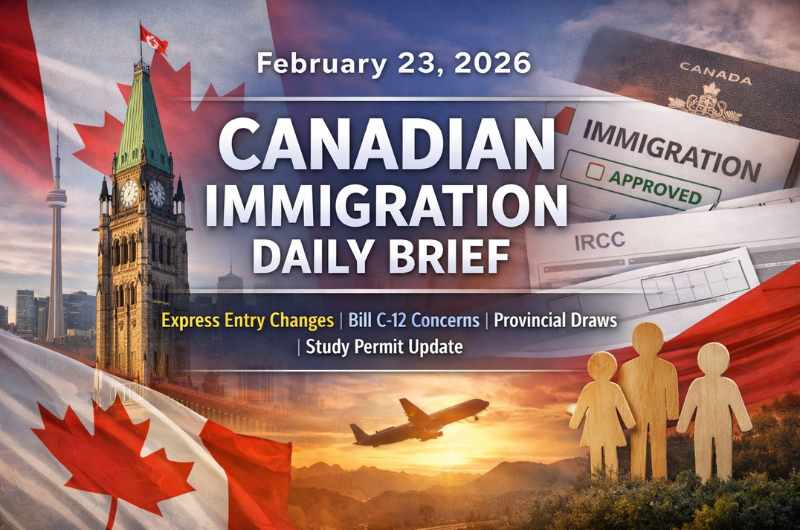
Canada Immigration Daily Brief – February 23, 2026
Canada immigration news for February 23, 2026 includes a major Express Entry work experience mandate, Senate warnings over Bill C-12, PEI and Alberta PNP draws, new study permit validity rules, and national immigration policy developments.
Major Shift: All Express Entry Categories Now Face New Work Experience Mandate
Immigration applicants aiming for Canadian permanent residency through the Express Entry system are facing a significant regulatory update concerning employment verification. Reports confirm that all occupational categories currently managed under the Express Entry framework will now be subject to a newly implemented work experience requirement.
This development marks a critical change for prospective immigrants, signaling a tightening of criteria across the board. Previously, certain National Occupational Classification (NOC) codes might have had more flexible requirements, but the current mandate brings uniformity, demanding documented proof of relevant professional history for all applicants, regardless of their specific trade or profession.
The governing body, Immigration, Refugees and Citizenship Canada (IRCC), has stated that these adjustments are being made to ensure that newcomers to Canada possess the immediately applicable skills required by the current labor market. This emphasis on verifiable experience is designed to smooth the transition for economic class immigrants into meaningful, long-term employment.
Stakeholders and immigration consultants are closely analyzing the specifics of the new documentation standards. Clarity is essential regarding the definition of ‘relevant’ experience, the required duration, and the acceptable forms of evidence from past employers to ensure successful applications moving forward.
This latest policy revision underscores the Canadian government’s commitment to selecting candidates who can contribute instantly to economic growth, prioritizing practical, demonstrated expertise over purely academic qualifications in the Express Entry selection process.
#ExpressEntry #CanadianImmigration #WorkExperience #IRCC #ImmigrationUpdate
GOP Demands Probe into Healthcare Access for Asylum Seekers
A significant political push is gaining momentum as Conservative lawmakers formally demand a comprehensive investigation into the current mechanisms governing healthcare access for individuals seeking asylum within the jurisdiction.
The call stems from growing concerns among the opposition regarding the administrative oversight and potential strain on public resources associated with providing medical services to this specific population group.
Sources indicate that the impetus for this formal request originates from recent budgetary reviews and anecdotal evidence suggesting potential inconsistencies or inadequacies in the system currently in place.
Conservatives argue that ensuring fiscal responsibility alongside compassionate care requires complete transparency regarding how these services are funded, delivered, and utilized by asylum seekers across various provinces or states.
#AsylumSeekers #HealthcareAccess #PoliticalInvestigation #ConservativeAction #PublicFunding
Senator and Legal Experts Warn Bill C-12 Immigration Changes Grant Excessive Authority to Cabinet and Department
A contentious piece of legislation, Bill C-12, is facing significant backlash from within the Senate and various legal rights organizations who argue that its proposed immigration reforms grant an alarming degree of power to both the federal cabinet and the relevant government department.
Senator McPhedran, a prominent voice in this debate, has publicly expressed serious concerns regarding the balance of authority embedded within the bill’s current structure. The apprehension centers on the potential for discretionary power to become overly concentrated, which critics suggest could undermine established principles of administrative fairness and transparency within the immigration system.
Legal rights groups have echoed these concerns, framing the changes as potentially ‘dangerous.’ Their analysis indicates that the legislation, as written, allows for broad interpretations and ministerial directives that could significantly impact the rights and processing of individuals navigating Canada’s immigration pathways. The fear is that this centralization of decision-making authority lacks necessary checks and balances.
These organizations are advocating for amendments that would introduce clearer guidelines and enhance judicial or independent oversight mechanisms, ensuring that any significant alterations to immigration policy remain subject to rigorous public and legal scrutiny. The current framework, they contend, tips the scale too far toward executive discretion.
#BillC12 #ImmigrationReform #CanadianSenate #LegalRights #CabinetPower
Prince Edward Island Extends 109 Invitations to Prospective Permanent Residents
Prince Edward Island (PEI) has actively moved forward with its Provincial Nominee Program (PNP) by issuing a significant batch of invitations to individuals interested in seeking permanent residency in the province.
The recent announcement confirms that 109 invitations were distributed to candidates across various streams of the immigration pathway, signaling the province’s continued commitment to attracting skilled workers and entrepreneurs to support its growing economy and population needs.
This latest round of invitations is a crucial step in PEI’s strategy to bolster its local workforce across key sectors. Candidates who received notifications will now move into the next phase of the application process for provincial nomination, a vital precursor to applying for permanent residence status with the federal government.
Immigration plays an increasingly pivotal role in the demographic and economic landscape of Atlantic Canada, and these consistent invitation rounds underscore PEI’s reliance on newcomers to fill labor shortages and sustain community growth.
#PrinceEdwardIsland #PNP #PermanentResidency #CanadianImmigration #PEI
Alberta Accelerates Immigration Goals with Multiple Provincial Draws
The province of Alberta has recently conducted a series of significant immigration draws, issuing hundreds of invitations to prospective permanent residents across six distinct draws. This concerted effort underscores the province’s commitment to attracting skilled global talent necessary to bolster its growing economy and meet specific labor market demands.
These frequent draws suggest a dynamic and responsive Provincial Nominee Program (PNP) structure, likely tailored to target specific occupation codes or Express Entry profiles that align closely with Alberta’s current economic priorities. Such targeted draws are crucial for ensuring that new immigrants possess skills that can immediately integrate into high-demand sectors.
While the exact breakdown of the streams utilized in these six draws was not fully detailed, the sheer volume of invitations issued in a short span signals an aggressive recruitment strategy. This approach helps Alberta compete effectively with other provinces seeking to attract highly skilled newcomers through Canada’s broader immigration pathways.
Immigration stakeholders often view multiple, frequent draws as a positive indicator for candidates in the pool, suggesting that the province is actively processing applications and is keen to welcome new residents. This activity confirms Alberta’s role as a key destination within the Canadian immigration landscape.
#AlbertaImmigration #PNP #ExpressEntry #SkilledWorkers #CanadianImmigration
Crucial First Step: Study Highlights the Importance of Entry Status for Highly Skilled Immigrant Success
A recent examination has placed a significant emphasis on the role of an immigrant’s initial status upon arrival in determining their long-term professional success within a new country. The findings, detailed in a recent study, suggest that the classification under which highly qualified individuals enter the system has a far greater predictive power than previously assumed.
This research delves into the outcomes for highly skilled immigrants, often recruited for their advanced education and specialized expertise. While the general narrative suggests that these professionals should integrate rapidly into high-value roles, the data indicates a substantial variation in post-arrival trajectories. This variation is strongly correlated with the specific category of entry visa or status held at the port of entry.
For many highly qualified immigrants, securing a position commensurate with their skills remains a persistent challenge, often leading to underemployment or career downgrading. The study posits that the initial institutional recognition afforded by their entry status dictates immediate access to professional networks, licensing bodies, and suitable job markets. An advantageous initial status appears to act as a critical catalyst, smoothing the path toward economic integration.
Conversely, those entering under less favorable or conditional statuses may face prolonged administrative hurdles, delays in credential recognition, or immediate barriers to employment, effectively stalling their career momentum before it can even begin. The implications for policy reform are substantial, suggesting that streamlining and optimizing the initial categorization process is paramount for maximizing the return on investments made in attracting global talent.
This underscores a critical point for policymakers: the administrative entry point is not merely a bureaucratic gateway but a foundational determinant of human capital utilization. Ensuring that the classification aligns accurately and immediately with the individual’s skill level can significantly reduce friction in the integration process.
#ImmigrationPolicy #SkilledImmigrants #EconomicIntegration #CredentialRecognition #LaborMarket
Key Issues Under Scrutiny: Critical Minerals, VIA Rail Service, and Immigration Take Center Stage
Recent political and policy discussions have placed three distinct, yet nationally significant, areas under intense scrutiny: the strategic importance of critical minerals, the ongoing evolution and funding of VIA Rail services, and the dynamics surrounding national immigration policies.
The focus on critical minerals underscores the growing global demand for resources essential to advanced technologies, renewable energy infrastructure, and national security. Policymakers are keenly assessing domestic supply chains, regulatory frameworks, and international partnerships required to secure these vital resources for future economic competitiveness.
Simultaneously, the state of Canada’s national passenger rail service, VIA Rail, continues to draw attention. Debates likely center on infrastructure upgrades, route expansion, and ensuring reliable, efficient service across the vast Canadian landscape, balancing operational costs with public necessity.
Further compounding the national agenda is the ongoing conversation surrounding immigration. This topic encompasses federal targets, economic stream integration, and processing backlogs, all of which significantly influence demographic targets and workforce development.
The convergence of these three disparate files—resource security, national transportation infrastructure, and population planning—suggests a period of focused legislative and governmental action as officials attempt to address immediate challenges while setting long-term strategic direction.
iPolitics appears to be tracking these developments closely, highlighting how these diverse subjects are simultaneously influencing the current governmental timetable.
#CriticalMinerals #VIARail #ImmigrationPolicy #CanadianPolitics #ResourceSecurity
Canada Tightens Rules: Study Permit Validity Reduced for Prerequisite Course Students
The Canadian government has recently implemented a significant change regarding the duration of study permits issued to international students who are enrolled in prerequisite courses. This adjustment aims to refine the immigration pathways and ensure that study permits accurately reflect the intended duration of study, particularly for those preparing to enter full academic programs.
Historically, students undertaking foundational or preparatory studies often received permits aligned with the expected completion timeline of these prerequisites. However, the new directive dictates a shorter validity period for these initial permits. This move is likely intended to prevent situations where students hold long-term permits based solely on preliminary enrollment, thereby encouraging a more direct transition into their primary degree or diploma programs.
This modification places added administrative responsibility on prospective international students. They will now need to meticulously plan their academic timelines and ensure they apply for extensions or new permits promptly as they transition from prerequisite studies to their main course of instruction. Failure to adhere to the new validity timelines could result in unintended immigration complications.
The policy shift suggests a heightened scrutiny of the educational journey of international students in Canada, emphasizing clear, linear progression toward recognized post-secondary credentials. Stakeholders, including educational consultants and designated learning institutions, are expected to disseminate this updated information widely to incoming cohorts.
#CanadaImmigration #StudyPermit #InternationalStudents #EducationPolicy #PrerequisiteCourses
Canada Moves to Strip Citizenship from Alleged Mumbai Attack Terrorist
The Canadian government has initiated legal proceedings aimed at revoking the citizenship of an individual strongly implicated in connections to the devastating 2008 Mumbai terrorist attacks.
This development signals a firm stance by Canadian authorities regarding national security and the integrity of its citizenship process, particularly concerning individuals associated with internationally recognized acts of terrorism.
The legal challenge represents a significant step in addressing allegations that have shadowed the individual for some time, moving the matter into the formal judicial arena for a final determination.
While specific details regarding the evidence underpinning the revocation request remain under review within the court system, the action underscores the seriousness with which Canada views its obligations to counter terrorism and ensure that citizenship is not retained by those who pose a risk to public safety or whose acquisition of status was allegedly fraudulent in light of their activities.
#CanadianPolitics #TerrorismCharges #CitizenshipRevocation #MumbaiAttacks #NationalSecurity
One Year Later: Ukrainian Refugees Find Stability and Community on Prince Edward Island
As the somber anniversary of the full-scale invasion of Ukraine arrives, Ukrainian individuals and families who have sought refuge on Prince Edward Island (P.E.I.) are reflecting on a year of profound upheaval and the subsequent process of building new lives.
The journey for these newcomers has involved overcoming immense personal challenges, including displacement from their homeland and the emotional toll of the ongoing conflict. However, reports indicate a growing sense of settling in and integration within the welcoming communities across the island.
This period of transition is marked by tangible steps toward stability, including finding sustained housing, enrolling children in local schools, and beginning to engage with the job market. These foundational elements are crucial for long-term adaptation and recovery.
Marking the anniversary serves as a poignant moment for both reflection on the horrors left behind and an acknowledgment of the resilience demonstrated in forging a new normal. Community support systems on P.E.I. have played a vital role in facilitating this difficult but necessary adjustment.
While the emotional connection to Ukraine remains strong, the focus is increasingly shifting towards future prospects and contributing to their new island home.
#PEI #UkrainianRefugees #WarAnniversary #CommunitySupport #NewBeginnings
Source: NEXUS Conferences & Canadian media sources
Assessment Form: Click here