Canada Immigration Daily Update – February 18, 2026
Canada Immigration Daily Update – February 18, 2026
Canada Immigration Daily Brief – February 18, 2026
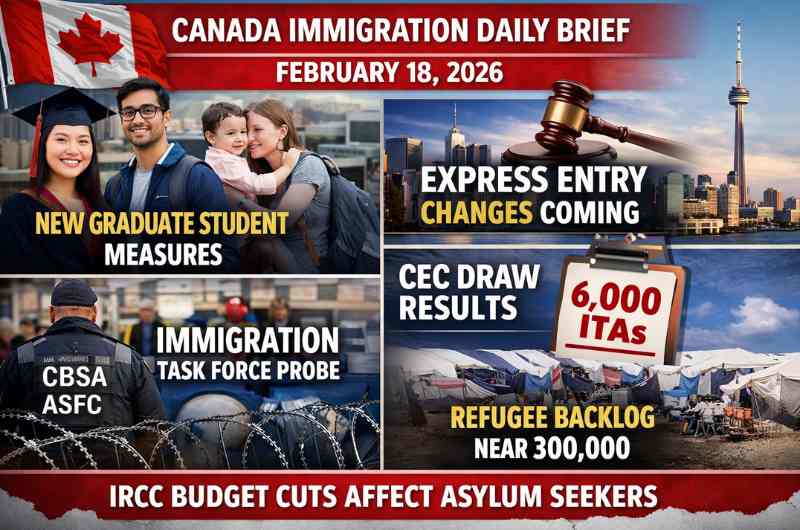
Canada immigration update for February 18, 2026: IRCC issued 6,000 ITAs in a CEC-only Express Entry draw, new graduate student family measures announced, refugee backlog stabilizes near 300,000, asylum seekers face healthcare co-payments, and major Express Entry category changes are expected.
Canada Opens Doors Wider: New Measures Aim to Attract More Foreign Graduate Students and Their Families
The Immigration Department has announced significant new initiatives aimed at bolstering the country’s appeal to international academic talent. These measures are specifically designed to attract a greater number of foreign graduate students to pursue their advanced studies within the nation’s educational institutions.
This strategic shift underscores a commitment to fostering innovation and research by drawing in top-tier global scholars. The heightened focus on graduate students highlights a recognition of their potential profound contributions to the economy, academic research landscape, and overall cultural diversity of the nation.
A pivotal component of these new offerings is the explicit provision for international graduate students to bring their immediate families to the country. This crucial amendment seeks to alleviate common concerns faced by prospective students, thereby making the transition smoother and the study environment more conducive to long-term academic pursuits without the burden of family separation.
By addressing both the professional aspirations of students and their personal well-being, the department aims to enhance Canada’s competitive edge on the global stage for academic recruitment. This holistic approach is expected to make Canada a more attractive destination for those seeking advanced education, potentially leading to increased enrollment and a more robust research ecosystem.
#ImmigrationCanada #InternationalStudents #GraduateStudies #FamilyMigration #CanadaImmigration
Hundreds Targeted: Canadian Immigration Officers Join Extortion Task Force Probe
A significant operation is underway as Canadian immigration officers become actively involved in investigating hundreds of individuals identified through the efforts of a dedicated extortion task force. This collaborative effort signals a serious escalation in cross-agency focus on combating organized financial crime impacting immigration processes and statuses within the country.
The involvement of immigration officials suggests that the identified cases may involve individuals who utilized fraudulent means or coercion related to their applications, status maintenance, or citizenship processes. This intersection of criminal finance and immigration law enforcement is a complex area requiring specialized expertise from both agencies.
While specific details regarding the nature of the extortion or the exact number of individuals under scrutiny remain forthcoming, the mobilization of significant investigative resources points to a widespread pattern of illicit activity. Authorities are likely focused on determining the scope of the network and the extent to which immigration pathways were compromised for financial gain.
This development underscores the government’s commitment to maintaining the integrity of Canada’s immigration system. The findings from this joint investigation are expected to lead to substantial legal proceedings and potential administrative actions against those found complicit in these schemes.
#ImmigrationInvestigation #ExtortionTaskForce #CanadianLaw #BorderIntegrity #FinancialCrime
Major Policy Shift Imminent: Immigration Minister to Detail Express Entry Category Changes
Immigration Minister is scheduled to make a significant announcement in the coming days concerning forthcoming modifications to the Express Entry system’s category selection process. This development is highly anticipated by prospective immigrants, industry stakeholders, and various provincial nomination programs that rely heavily on the federal Express Entry mechanism for skilled worker intake.
The Express Entry system is the primary federal platform used to manage applications for Canadian permanent residence under programs such as the Federal Skilled Worker Program, the Federal Skilled Trades Program, and the Canadian Experience Class. Any alteration to the category cutoffs or selection criteria can substantially reshape the landscape for individuals hoping to immigrate under these skilled migration pathways.
While specific details regarding the nature of the announcement remain under wraps, sources suggest the changes could involve adjusting how candidates are ranked based on specific occupational needs, language proficiency thresholds, or educational streams. Such refinements are typically introduced to better align the incoming workforce with current labor market demands across Canada.
Stakeholders are keenly observing whether this announcement will introduce new category-based selection rounds, which have been explored by the government as a targeted approach to filling crucial gaps in sectors facing acute labor shortages. The Minister’s statement will provide necessary clarity on the future trajectory of high-skilled immigration processing.
#ExpressEntry #ImmigrationAnnouncement #SkilledImmigration #CanadianImmigration #IRCC
Record Invitation Wave: Express Entry Draw #396 Targets 6,000 CEC Applicants
Immigration, Refugees and Citizenship Canada (IRCC) has successfully concluded Express Entry Draw number 396, marking a significant moment for permanent residency hopefuls across the nation. This latest invitation round focused exclusively on candidates within the Canadian Experience Class (CEC) category, signaling a targeted approach to bolstering the domestic talent pool.
The draw saw a substantial volume of Invitations to Apply (ITAs) issued, totaling precisely 6,000 candidates who met the minimum cut-off score criteria for this specific stream. The selection of CEC candidates suggests a strategic governmental focus on retaining individuals who have already established a significant presence and professional history within the Canadian labor market.
The Canadian Experience Class pathway is specifically designed for temporary residents, such as international graduates and skilled temporary workers, who possess valuable Canadian work experience. By prioritizing this group, the government aims to streamline the transition from temporary status to permanent residency, thereby ensuring that essential skills and local knowledge remain within the country.
While the specific cut-off score for this CEC-only draw was not detailed in the summary, the high number of invitations issued indicates a robust intake target for this cohort in the current immigration cycle. Such targeted draws are crucial for balancing the overall volume of immigrants admitted annually while addressing specific national economic or demographic needs.
Candidates in the Express Entry pool who possess CEC eligibility should closely monitor their accounts for notifications regarding this significant allocation of ITAs. This round confirms the ongoing operational tempo of the Express Entry system as a primary vehicle for skilled economic immigration to Canada.
#ExpressEntry #CEC #ImmigrationCanada #ITADraw #PermanentResidency
Refugee Claims Dip in January as Canada’s Intake Backlog Holds Steady Near 300,000 Mark
Immigration data released for January 2026 indicates a notable, albeit minor, decrease in the volume of new refugee claims lodged across Canada during that month. This recent trend offers a slight deviation from the high intake figures recorded in preceding periods, suggesting a potential plateau in the pressure being placed on the country’s asylum processing system.
While the absolute number of new claimants saw a reduction, the overall backlog of pending refugee cases remains a significant operational challenge. Sources within ImmigCanada confirm that the accumulated caseload has stabilized around the substantial threshold of 300,000 unresolved applications. This stabilization implies that while new inflows may have slightly moderated, the existing queue continues to require intensive resource allocation for resolution.
The implications of this stabilization are multifaceted. For processing centers, maintaining a near-300,000 case load means continued strain on administrative capacity and personnel. For the claimants awaiting decisions, it translates into extended periods of uncertainty regarding their status in Canada, impacting their ability to fully integrate into the economy and society.
Government officials will likely analyze the January figures closely to determine if this decline represents a temporary fluctuation or the beginning of a sustained trend. Any long-term reduction in new claims would allow processing bodies to potentially redirect resources toward adjudicating the entrenched backlog, thereby working toward alleviating the extensive waiting times currently experienced by thousands.
#CanadaImmigration #RefugeeClaims #AsylumBacklog #ImmigCanada #ImmigrationData
New Analysis Reveals Asylum Seekers Will Bear the Heaviest Burden of IRCC Funding Reductions
Recent analyses indicate that incoming changes to Immigration, Refugees and Citizenship Canada (IRCC) funding are poised to disproportionately impact asylum seekers. The core of the impending fiscal adjustment involves the introduction of co-payments for essential services, specifically dental care and prescription drug coverage.
This shift in financial responsibility signals a significant policy change for individuals seeking refuge and temporary status within the country. Previously, these crucial health and medical needs were largely covered under existing government provisions, ensuring a baseline level of care for those awaiting status determination.
The decision to implement co-payments means that asylum seekers, many of whom have extremely limited or no access to external employment income, will now face out-of-pocket costs for necessary dental procedures and essential medications. Experts suggest this move could create substantial barriers to accessing timely and necessary healthcare.
The Ottawa Citizen has reported on this analysis, highlighting concerns that these new financial hurdles may force vulnerable individuals to forgo treatment, leading to potentially severe long-term health consequences. The government’s rationale for the cuts is likely rooted in broader budgetary constraints, yet the impact on this specific demographic remains a critical area of debate.
The introduction of these cost-sharing measures fundamentally alters the support structure available to new arrivals. Stakeholders are urging a review of the policy’s implementation timeline to mitigate the immediate financial shock to this population segment.
Further examination of the data suggests that these specific cuts targeting dental and prescription coverage represent one of the most direct fiscal impacts stemming from the overall IRCC budget trimming exercise.
#IRCCCuts #AsylumSeekers #HealthcareAccess #DentalCoverage #RefugeePolicy
Border Strategy Deploys New Signage to Deter Immigrant Drivers from Crossing into Canada
Authorities at a key bridge connecting to Canada have implemented a new measure aimed at curbing a specific pattern of immigration-related activity. The focus of this initiative is a newly installed sign, strategically placed to intercept and inform potential immigrant drivers before they attempt to cross the international boundary.
This development signals an attempt by local or federal agencies to mitigate what has been described as a ‘trap’ scenario. While the precise nature of this alleged trap is not immediately clear from the information provided, the existence of the sign suggests that individuals seeking entry into Canada via this route have previously encountered unforeseen complications or adverse conditions upon arrival or shortly after crossing.
The installation of such highly visible signage often precedes or accompanies heightened enforcement activities or informational campaigns designed to manage cross-border flows. By proactively providing information, officials hope to reduce the number of individuals who might find themselves in precarious or illegal situations after making the journey.
Stakeholders involved in immigration advocacy and border security are likely monitoring the effectiveness of this signage. Its success will be measured by a reduction in incidents related to the targeted ‘trap,’ as well as overall border management efficiency at this critical crossing point.
#BorderSecurity #ImmigrationPolicy #CanadaCrossing #TrafficManagement #BorderStrategy
Saskatoon Population Soars to 316,000, Signaling Rapid Urban Expansion
Saskatoon has officially surpassed a significant population milestone, with the city’s population reaching 316,000, according to recent figures released by municipal authorities. The announcement confirms a trend of rapid expansion for the Saskatchewan city, which has seen consistent growth in recent years. This new benchmark reflects the increasing attractiveness of Saskatoon as a destination for both new immigrants and internal Canadian migration.
The surge in population presents both opportunities and challenges for city planners and policymakers. While rapid growth can stimulate economic activity and foster a dynamic urban environment, it also places considerable strain on existing infrastructure, including housing, transportation networks, and public services. Addressing these pressures efficiently will be crucial for managing future expansion and maintaining a high quality of life for residents.
This population increase places Saskatoon among Canada’s fastest-growing urban centers, prompting discussions about long-term development strategies. City officials are likely to analyze the implications of this growth on municipal budgets, land use planning, and the provision of essential services. The goal moving forward will be to ensure that infrastructure development keeps pace with the demographic changes, supporting sustained and orderly expansion in the years to come.
The data confirms Saskatoon’s evolving status from a regional hub to a burgeoning metropolis. The city’s ability to attract and retain new residents suggests strong economic fundamentals and community appeal. As the population continues to climb, focus will shift to how Saskatoon manages the transition, ensuring that its identity and liveability are preserved amidst rapid development.
#Saskatoon #PopulationGrowth #UrbanDevelopment #CityPlanning #Saskatchewan #Demographics
Montreal’s Tourism Sector Surges 7%, Fueled by Unexpected Influx of Visitors from the Maritimes
Montreal’s tourism industry has experienced a significant boost, registering a robust 7% rise in visitors, according to recent data. This growth spurt solidifies the city’s appeal as a top destination, attracting both domestic and international travelers. While the increase is positive overall, the most surprising element of this data release was the specific source of a portion of this new visitor traffic.
The surge in tourism figures was notably propelled by an unexpected spike in visitors originating from the Maritimes region of Canada. Industry analysts often track visitor demographics to identify key markets, but the substantial increase in travelers from the Atlantic provinces was described as a surprise development. This shift could indicate changing travel preferences among Canadians or successful targeted campaigns drawing new interest from previously less-represented regions.
This positive trend for Montreal’s tourism sector suggests strong economic benefits for local businesses, including hotels, restaurants, and cultural institutions. The 7% rise contributes significantly to the city’s post-pandemic recovery and highlights its ongoing success in attracting diverse traveler segments. The unexpected influx from the Maritimes offers valuable insights for future marketing strategies, suggesting a new, previously untapped demographic seeking experiences in Montreal.
#MontrealTourism #QuebecTravel #Maritimes #CanadianTravel #EconomicGrowth #VisitorStatistics
Source: NEXUS Conferences & Canadian media sources
Assessment Form: Click here