
Category-Based Occupation List for Express Entry Canada – 2026– Your Pathway to Permanent Residency
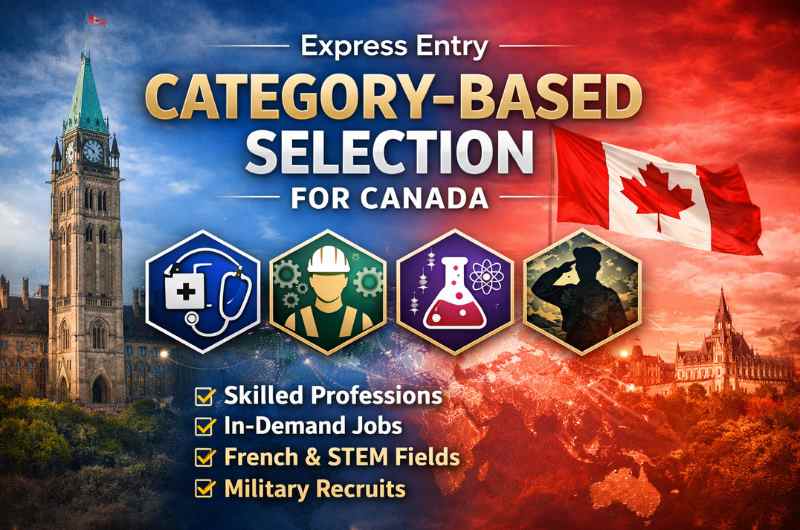
The express-entry-category-based-occupation-list is a powerful tool introduced by IRCC to better target skilled workers for permanent residency in Canada. This new approach helps streamline immigration by focusing on candidates with in-demand experience or French-language proficiency. Understanding how this system works—and whether your job is on the list—could make all the difference in your immigration journey.
Canada’s Express Entry system is one of the fastest and most popular ways for skilled workers to immigrate and gain permanent residency. In 2023, Immigration, Refugees and Citizenship Canada (IRCC) introduced category-based selection, a game-changing update to the program. This approach targets candidates with specific skills, training, or language abilities to meet Canada’s economic needs and labor market demands. If you’re looking to move to Canada, understanding category-based selection could be your key to success!
Table of Contents
What is Category-Based Selection?
Category-based selection is a targeted approach within the Express Entry system that allows Immigration, Refugees and Citizenship Canada (IRCC) to invite candidates who meet specific economic priorities identified by the Minister of Immigration.
In category-based rounds of invitations, IRCC selects candidates from the Express Entry pool who are eligible under a category established by the Minister to meet an identified economic goal. Categories may be based on criteria such as:
- Ability to communicate in a specific official language
- Work experience in a specific occupation
- Education
Candidates who meet the criteria for a category are ranked using the Comprehensive Ranking System (CRS), and the highest-ranking candidates in that category may receive an Invitation to Apply (ITA).
Once invited, candidates have 60 days to submit a complete application for permanent residence under one of the three Express Entry programs:
- Federal Skilled Worker Program (FSWP)
- Canadian Experience Class (CEC)
- Federal Skilled Trades Program (FSTP)
Step-by-Step Guide to Category-Based Selection in Express Entry
Category-based selection follows the same general Express Entry process, with one important difference: in certain rounds, IRCC invites candidates who meet specific category requirements in addition to having strong CRS scores.
Here’s how it works:
1- Create Your Express Entry Profile
First, you must create an online Express Entry profile through your secure IRCC account.
In your profile, you’ll provide details about your:
-
Work experience
-
Education
-
Language test results
-
Age
-
Other relevant background information
This profile shows IRCC that you’re interested in immigrating to Canada through Express Entry.
2- Enter the Express Entry Pool
If you meet the eligibility requirements for one of the three federal programs under Express Entry, you’ll be placed into the Express Entry pool:
-
Federal Skilled Worker Program (FSWP)
-
Canadian Experience Class (CEC)
-
Federal Skilled Trades Program (FSTP)
Only candidates in the pool can be considered for invitations.
3- Receive Your CRS Score
Once in the pool, IRCC assigns you a score under the Comprehensive Ranking System (CRS). You can see your CRS score directly in your IRCC account.
4- IRCC Identifies Candidates Eligible for a Category
If IRCC conducts a category-based draw, they will first identify candidates in the pool who meet the requirements of a specific category established by the Minister.
Categories may be based on:
-
Strong French-language ability
-
Work experience in specific occupations
-
Other economic priorities
Only candidates who meet the category requirements will move to the next step in that specific draw.
5- Candidates Are Ranked by CRS Score
Even in category-based rounds, candidates are still ranked according to their CRS score.
Among those who qualify for the category, the highest-ranking candidates are selected first.
6- IRCC Runs a Round of Invitations
IRCC then issues Invitations to Apply (ITAs) to the highest-ranking eligible candidates.
In category-based draws:
- You must qualify for the selected category, and
- You must have a competitive CRS score compared to others in that category.
7- Apply for Permanent Residence
If you receive an Invitation to Apply (ITA), you have 60 days to submit a complete application for permanent residence under the specific Express Entry program you qualified for.
You must upload all required documents within this deadline.
8- IRCC Makes a Final Decision
IRCC reviews your application to confirm:
- You meet the program requirements
- You meet the category requirements (if applicable)
- The information in your profile was accurate
- You are admissible to Canada (medical, security, criminal checks)
If everything is approved, you will receive permanent residence.
Current Categories Under Express Entry
Immigration, Refugees and Citizenship Canada (IRCC) has established specific categories within Express Entry to address Canada’s economic and labour market needs. These categories are determined by the Minister of Immigration and may change over time.
As of now, the current category-based selection groups include:
1- French-language proficiency
Candidates with strong French-language skills may be invited to apply, particularly to support Francophone communities outside Quebec.
2- Healthcare and social services occupations
Includes a range of healthcare professionals and support workers who help meet Canada’s growing healthcare demands.
3- Science, Technology, Engineering and Math (STEM) occupations
Targets professionals in key technical and innovation-focused fields.
4- Trade occupations
Skilled trades workers in construction, industrial, electrical, mechanical, and related fields.
5- Education occupations
Includes teachers, early childhood educators, and other education professionals.
6- Transport occupations
Workers in transportation and logistics sectors that support Canada’s supply chain and infrastructure.
7- Physicians with Canadian work experience
Medical doctors who have gained eligible work experience in Canada.
8- Senior managers with Canadian work experience
High-level executives and senior business leaders with qualifying Canadian experience.
9- Researchers with Canadian work experience
Individuals contributing to research and innovation within Canada.
10- Skilled military recruits
Eligible candidates with military training or recruitment qualifications aligned with Canada’s needs.
Important to Understand
Category-based rounds are designed to supplement general and program-specific Express Entry draws, not replace them.
In some cases, IRCC may not need to conduct a category-based draw if enough top-ranking candidates in that category are already being invited through regular (general or program-specific) rounds.
This means:
- Being eligible for a category does not guarantee a category-based draw will occur.
- You may still receive an invitation through a general draw if your CRS score is competitive.
Who’s Eligible for the French-Language Proficiency Category?
To be eligible for an invitation under the French-language proficiency category, you must:
-
Be eligible for Express Entry under one of the three federal programs:
-
Federal Skilled Worker Program (FSWP)
-
Canadian Experience Class (CEC)
-
Federal Skilled Trades Program (FSTP)
-
-
Have valid French-language test results showing a minimum score of NCLC 7 in all four language abilities:
-
Reading
-
Writing
-
Listening
-
Speaking
-
-
Meet all additional requirements outlined in the Ministerial instructions for that specific round.
Full eligibility details are provided in the official instructions for each category-based round.
Who’s Eligible for Occupation-Based Categories?
(Healthcare, STEM, Trades, Education, or Transport)
To be eligible for an invitation under any occupation-based category (Healthcare, STEM, Trades, Education, or Transport), you must:
-
Be eligible for Express Entry under one of the three federal programs:
-
Federal Skilled Worker Program (FSWP)
-
Canadian Experience Class (CEC)
-
Federal Skilled Trades Program (FSTP)
-
-
Have accumulated, within the past 3 years, at least 12 months of full-time work experience (or an equivalent amount of part-time experience)
-
The work experience does not need to be continuous
-
The experience must be in one single eligible occupation listed under the selected category
-
The experience may be gained in Canada or abroad
-
-
Meet all additional requirements outlined in the Ministerial instructions for that specific round.
Who’s eligible for Occupation-Based Categories with Canadian work experience category?
(Physicians, Senior Managers, and Researchers)
To be eligible for an invitation under the Physicians with Canadian Work Experience, Senior Managers with Canadian Work Experience, or Researchers with Canadian Work Experience categories, you must:
-
Be eligible for Express Entry under one of the three federal programs:
-
Federal Skilled Worker Program (FSWP)
-
Canadian Experience Class (CEC)
-
Federal Skilled Trades Program (FSTP)
-
-
Have accumulated, within the past 3 years, at least 12 months of full-time work experience (or an equivalent amount of part-time experience)
-
The work experience does not need to be continuous
-
The experience must be in one single eligible occupation listed under the applicable category
-
The experience must have been gained in Canada
-
-
Meet all additional requirements outlined in the Ministerial instructions for that specific round.
Who’s Eligible for the Skilled Military Recruits Category?
To be eligible for an invitation under the Skilled Military Recruits category, you must meet the following requirements:
1- Be a Foreign Skilled Military Applicant (FSMA)
You must be:
-
An eligible foreign national currently serving in a recognized foreign military
-
With a minimum of 10 years of continuous military service
2- Have Relevant Military Experience and Training
Your work experience and military training must align with the main duties of one or more of the following National Occupational Classification (NOC) codes:
-
NOC 40042 – Commissioned officers of the Canadian Armed Forces
-
NOC 42102 – Specialized members of the Canadian Armed Forces
-
NOC 43204 – Operations members of the Canadian Armed Forces
3- Have a Valid Offer of Arranged Employment
You must have an offer of arranged employment from the Canadian Forces Recruiting Group that:
-
Is for continuous, full-time work in Canada
-
Lasts for at least 3 years
-
Is under one of the NOC codes listed above
4- Meet Education Requirements
You must have at least a 2-year post-secondary credential.
If your education was completed outside Canada, you must obtain an Educational Credential Assessment (ECA) to demonstrate that it is equivalent to a Canadian credential.
5- Meet Express Entry and Round Requirements
You must:
-
Be eligible for Express Entry under one of the three federal programs (FSWP, CEC, or FSTP)
-
Meet all additional requirements outlined in the Ministerial instructions for that specific round
Full eligibility details are provided in the official instructions for each category-based round.
How IRCC Chooses and Reports on Categories?
IRCC does not choose categories randomly. Categories are established based on Canada’s economic priorities and labour market needs.
When selecting categories, IRCC considers:
- Labour market information and future workforce projections
- Input from provinces and territories
- Feedback from stakeholders across Canada
This ensures that category-based selection reflects real shortages and economic goals.
Transparency and Reporting
Each year, IRCC reports to Parliament on:
- The categories selected in the previous year
- Why and how those categories were chosen
- The official Ministerial instructions used to establish each category
- The number of Invitations to Apply (ITAs) issued under each category
IRCC also:
- Includes category-based selection data in the Express Entry Year-End Report
- Regularly monitors and assesses categories to determine whether adjustments are needed
This process helps maintain transparency and accountability in Canada’s immigration system.
Why Category-Based Selection Matters?
1. Higher Chances for In-Demand Jobs
If your occupation falls under one of the eligible categories—such as healthcare, trades, or education—you may receive an invitation to apply even with a lower CRS score than what’s typical in general draws. Similarly, French-speaking candidates often benefit from lower CRS cut-offs, as Canada continues to support Francophone immigration outside Quebec.
This creates an opportunity for qualified individuals who may have otherwise been overlooked in a purely score-based system.
2. Focused on Canada’s Real Needs
Rather than relying solely on a points-based ranking, category-based selection allows IRCC to directly target skills and sectors facing labor shortages. For example:
-
Nurses and healthcare workers are selected to support the aging population
-
Tradespeople are invited to fill construction and infrastructure gaps
-
Teachers and early childhood educators help meet education needs across provinces
This approach ensures that immigration serves both newcomers and the Canadian economy.
3. Updated Every Year
Each year, IRCC consults with provinces, territories, and labor market experts to determine which occupations and skills are most in demand. Categories are reviewed and adjusted to reflect:
-
New labor trends
-
Economic growth strategies
-
Demographic shifts
This means applicants can plan their immigration strategy by staying informed about annual changes and tailoring their profiles accordingly.
All Express Entry Category-Based Occupation List (NOC Codes)
Below is the complete list of eligible 2021 NOC codes under the current category-based selection system.
| Category | Occupation | NOC Code | TEER Category |
|---|---|---|---|
| Healthcare and social services occupations | Animal health technologists and veterinary technicians | 32104 | 2 |
| Healthcare and social services occupations | Audiologists and speech-language pathologists | 31112 | 1 |
| Healthcare and social services occupations | Cardiology technologists and electrophysiological diagnostic technologists | 32123 | 2 |
| Healthcare and social services occupations | Chiropractors | 31201 | 1 |
| Healthcare and social services occupations | Dental hygienists and dental therapists | 32111 | 2 |
| Healthcare and social services occupations | Dentists | 31110 | 1 |
| Healthcare and social services occupations | Dietitians and nutritionists | 31121 | 1 |
| Healthcare and social services occupations | General practitioners and family physicians | 31102 | 1 |
| Healthcare and social services occupations | Licensed practical nurses | 32101 | 2 |
| Healthcare and social services occupations | Massage therapists | 32201 | 2 |
| Healthcare and social services occupations | Medical laboratory assistants and related technical occupations | 33101 | 3 |
| Healthcare and social services occupations | Medical laboratory technologists | 32120 | 2 |
| Healthcare and social services occupations | Medical radiation technologists | 32121 | 2 |
| Healthcare and social services occupations | Medical sonographers | 32122 | 2 |
| Healthcare and social services occupations | Nurse aides, orderlies and patient service associates | 33102 | 3 |
| Healthcare and social services occupations | Nurse practitioners | 31302 | 1 |
| Healthcare and social services occupations | Nursing coordinators and supervisors | 31300 | 1 |
| Healthcare and social services occupations | Occupational therapists | 31203 | 1 |
| Healthcare and social services occupations | Optometrists | 31111 | 1 |
| Healthcare and social services occupations | Other medical technologists and technicians | 32129 | 2 |
| Healthcare and social services occupations | Other professional occupations in health diagnosing and treating | 31209 | 1 |
| Healthcare and social services occupations | Other technical occupations in therapy and assessment | 32109 | 2 |
| Healthcare and social services occupations | Paramedical occupations | 32102 | 2 |
| Healthcare and social services occupations | Pharmacists | 31120 | 1 |
| Healthcare and social services occupations | Pharmacy technical assistants and pharmacy assistants | 33103 | 3 |
| Healthcare and social services occupations | Pharmacy technicians | 32124 | 2 |
| Healthcare and social services occupations | Physician assistants, midwives and allied health professionals | 31303 | 1 |
| Healthcare and social services occupations | Physiotherapists | 31202 | 1 |
| Healthcare and social services occupations | Psychologists | 31200 | 1 |
| Healthcare and social services occupations | Registered nurses and registered psychiatric nurses | 31301 | 1 |
| Healthcare and social services occupations | Respiratory therapists, clinical perfusionists and cardiopulmonary technologists | 32103 | 2 |
| Healthcare and social services occupations | Social and community service workers | 42201 | 2 |
| Healthcare and social services occupations | Social workers | 41300 | 1 |
| Healthcare and social services occupations | Specialists in clinical and laboratory medicine | 31100 | 1 |
| Healthcare and social services occupations | Specialists in surgery | 31101 | 1 |
| Healthcare and social services occupations | Therapists in counselling and related specialized therapies | 41301 | 1 |
| Healthcare and social services occupations | Veterinarians | 31103 | 1 |
| Science, technology, engineering and math (STEM) occupations | Architecture and science managers | 20011 | 0 |
| Science, technology, engineering and math (STEM) occupations | Civil engineering technologists and technicians | 22300 | 2 |
| Science, technology, engineering and math (STEM) occupations | Civil Engineers | 21300 | 1 |
| Science, technology, engineering and math (STEM) occupations | Cybersecurity specialists | 21220 | 1 |
| Science, technology, engineering and math (STEM) occupations | Electrical and electronics engineering technologists and technicians | 22310 | 2 |
| Science, technology, engineering and math (STEM) occupations | Electrical and electronics engineers | 21310 | 1 |
| Science, technology, engineering and math (STEM) occupations | Geological Engineers | 21331 | 1 |
| Science, technology, engineering and math (STEM) occupations | Industrial and manufacturing engineers | 21321 | 1 |
| Science, technology, engineering and math (STEM) occupations | Insurance agents and brokers | 63100 | 3 |
| Science, technology, engineering and math (STEM) occupations | Mechanical Engineering Technologists and Technicians | 22301 | 2 |
| Science, technology, engineering and math (STEM) occupations | Mechanical Engineers | 21301 | 1 |
| Trade occupations | Contractors and supervisors, oil and gas drilling and services | 82021 | 2 |
| Trade occupations | Floor covering installers | 73113 | 3 |
| Trade occupations | Painters and decorators (except interior decorators) | 73112 | 3 |
| Trade occupations | Roofers and shinglers | 73110 | 3 |
| Trade occupations | Concrete finishers | 73100 | 3 |
| Trade occupations | Other technical trades and related occupations | 72999 | 2 |
| Trade occupations | Water well drillers | 72501 | 2 |
| Trade occupations | Electrical mechanics | 72422 | 2 |
| Trade occupations | Heating, refrigeration and air conditioning mechanics | 72402 | 2 |
| Trade occupations | Heavy-duty equipment mechanics | 72401 | 2 |
| Trade occupations | Construction millwrights and industrial mechanics | 72400 | 2 |
| Trade occupations | Bricklayers | 72320 | 2 |
| Trade occupations | Cabinetmakers | 72311 | 2 |
| Trade occupations | Carpenters | 72310 | 2 |
| Trade occupations | Gas fitters | 72302 | 2 |
| Trade occupations | Plumbers | 72300 | 2 |
| Trade occupations | Industrial electricians | 72201 | 2 |
| Trade occupations | Electricians (except industrial and power system) | 72200 | 2 |
| Trade occupations | Welders and related machine operators | 72106 | 2 |
| Trade occupations | Sheet metal workers | 72102 | 2 |
| Trade occupations | Machinists and machining and tooling inspectors | 72100 | 2 |
| Trade occupations | Home building and renovation managers | 70011 | 0 |
| Trade occupations | Construction managers | 70010 | 0 |
| Trade occupations | Butchers - retail and wholesale | 63201 | 3 |
| Trade occupations | Construction estimators | 22303 | 2 |
| Education occupations | Elementary and secondary school teacher assistants | 43100 | 3 |
| Education occupations | Instructors of persons with disabilities | 42203 | 2 |
| Education occupations | Early childhood educators and assistants | 42202 | 2 |
| Education occupations | Elementary school and kindergarten teachers | 41221 | 1 |
| Education occupations | Secondary school teachers | 41220 | 1 |
| Transport occupations | Air pilots, flight engineers and flying instructors | 72600 | 2 |
| Transport occupations | Automotive service technicians, truck and bus mechanics, and mechanical repairers | 72410 | 2 |
| Transport occupations | Aircraft mechanics and aircraft inspectors | 72404 | 2 |
| Transport occupations | Aircraft instrument, electrical and avionics mechanics, technicians and inspectors | 22313 | 2 |
| Physicians with Canadian work experience | General practitioners and family physicians | 31102 | 1 |
| Physicians with Canadian work experience | Specialists in surgery | 31101 | 1 |
| Physicians with Canadian work experience | Specialists in clinical and laboratory medicine | 31100 | 1 |
| Senior managers with Canadian work experience | Senior managers - construction, transportation, production and utilities | 15 | 0 |
| Senior managers with Canadian work experience | Senior managers - trade, broadcasting and other services | 14 | 0 |
| Senior managers with Canadian work experience | Senior managers - health, education, social and community services and membership organizations | 13 | 0 |
| Senior managers with Canadian work experience | Senior managers - financial, communications and other business services | 12 | 0 |
| Researchers with Canadian work experience | Post-secondary teaching and research assistants | 41201 | 1 |
| Researchers with Canadian work experience | University professors and lecturers | 41200 | 1 |
| Skilled military recruits | Operations Members of the Canadian Armed Forces | 43204 | 3 |
| Skilled military recruits | Specialized members of the Canadian Armed Forces | 42102 | 2 |
| Skilled military recruits | Commissioned officers of the Canadian Armed Forces | 40042 | 0 |
Related Resources
- For the newest updates on the Category-Based Occupation List, visit the official IRCC website.
- For the latest Express Entry draw results, including category-based and general draws, visit the official IRCC page.
- Learn more about Express Entry programs
- Express Entry Draws